Tuesday, April 3, 2018

My Roots of Optimism

My Roots of Optimism

The year was 1947. Location: India. India was on the cusp of independence from over 100 years of British rule but was scarred by partition into India and Pakistan. People were being ruthlessly dragged out of their own homes and getting their heads chopped off with a dagger. An innocent baby was trapped in all of this. Her neighbors and family friends were brutally slaughtered. The baby’s mom had already been warned that the same fate would occur to them. Like 40 million other people, the family left their home with fear in their eyes, and hope of reaching India, someday. The streets where kids used to play were now drenched in blood. They longed for helping hands, but their pleas went unheard. The family somehow managed to reach the Indian city of Amritsar and lived in a cramped refugee camp for many months. The time of a life that was supposed to be filled with laughter, happiness, and joy for the baby was replaced by the sounds of grief and depression. That baby was my grandmother.

Like a rose amongst the thorns, nonviolence advocate, Mahatma Gandhi, was doing his best to curb the violence and spread a message of peace and optimism. Whether it was Indian values, culture, upbringing, or Mahatma Gandhi's message, it made my grandparents more humble, tolerant, compassionate, and most importantly, optimistic.

Even after losing everything, and living a harsh refugee life, my grandma’s family always stayed positive, and looked on the brighter side of things. Instead of being disappointed, they felt happy to be alive and looked forward to a successful life. My grandma and her siblings worked hard, never looked back, and became well-educated and prosperous.

Life has not been very favorable to her. My grandma lost her husband early, however she stayed strong and single-handedly raised her children. Thereafter, she moved to the U.S., and is now taking care of us. Through these setbacks, my grandma stayed strong and never lost hope.

These values of compassion, hope, and strength were passed onto my parents and are now my roots of optimism. I am glad to note that even in modern times, optimism is as thriving as ever, and it brings me hope to see so many organizations working to bring a positive change in our community.

I am a board member of the Make-A-Wish Foundation and fund-raise to fulfill wishes of critically ill children. This brings them happiness and hope for their recovery. I also teach dance routines to mentally and physically challenged kids through a nonprofit organization called Jeena. This helps them integrate better with society, and it improves their motor, memory, and social skills.

Through these activities I am bringing optimism to those who are unable to live a typical life but none of these kids have given up. Despite being handicapped, or ill, they find something that makes them happy and gets them through the day – be it dancing, singing, or looking forward to their wish getting fulfilled.

By virtue of Indian values and grandmother’s influence, my roots of optimism run deep and strong, and positive experiences continue to nurture them. I want to spread optimism and bring a positive change to my community. And while I can't solve all of the problems in the world, if I can be the reason a handicapped kid feels welcomed in society, I am doing my part. If I can be the reason that a severely ill child regains hope for their recovery, I am doing my part. If I can be the reason that someone smiles and laughs and passes it on, I am doing my part. If everyone did their own part, optimism will continue to thrive.

Monday, March 12, 2018

Can Society Function Without Respect?


An ideal society is a community where its citizens work together for the benefit of everyone. Over the years, many societies have flourished, while others have collapsed because they lacked respect - whether that is for different genders, cultures, authority, or the environment. I firmly believe that respect is the foundation for a successful society, and an absence of respect ensures failure.

As per the Hindu mythology, Lord Vishnu had several incarnations, from early aquatic life to humans, and his latest incarnation, Lord Krishna, was part of a society that was intended to be Utopian. However, this society collapsed for not respecting women. During a gambling game between the two contenders of the throne, the Pandavas and Kauravas, the Pandavas put their wife at stake, and eventually lost her to the Kauravas. Disrespecting their wife by putting her up for gamble and sexually assaulting her were huge mistakes by the Pandavas and the Kauravas respectively. This led to an epic war, known as the Mahabharata, in which, it is claimed that all of mankind was wiped out, and what was believed to be a Utopian society crumbled due to the lack of respect. A more recent example is the Taliban, who disrespected women in Afghanistan and deprived them of education. This led youth activist, Malala Yousafazai, to start a global movement that toppled Afghanistan’s Taliban government, proving that a society without respect is not sustainable.

During the 1900’s, in Europe, different cultures and ideas were not respected and the anti-Semitic leader of the Nazis, Adolf Hitler, strongly believed that Germans were superior, especially to Jews. Hitler wanted an “Aryanization” of Europe, which meant that he wanted to exterminate any group who was not Aryan, or “pure.” Due to this belief, the Nazis tortured Jews and violated their rights. As a primary target, approximately 6 million Jews were brutally slaughtered along with others including the Polish, Gypsies, handicapped, and homosexuals, who Hitler deemed inferior to the Aryans. This disdain of other cultures and violation of basic rights happened under the cover of World War II. In the end, the society that Hitler persisted on creating collapsed because it was a community where different thoughts, beliefs, and cultures were scorned.

An important aspect of a well-functioning society is respect for its institutions and authority. A government is necessary to maintain law and order, however if not everyone abide by the rules, and respect authority, the society could quickly plunge into chaos. Our world is dotted with examples of various terrorist organizations such as Al-Qaeda, Ku Klux Klan (KKK), ISIS, and Boko Haram that have forcefully taken over territories, disrespecting and disregarding the government and its constituents. Instead of following the rules and participating in the electoral process, they chose to go against the government, violate human rights, and spread terror. Many areas that have been invaded by such terrorist groups are now in chaos, and on the path to become failed states. In contrast, the biggest and oldest democracies in the world, India and the United States, both have thriving societies because they respect the institution.

Environment is considered an insignificant factor of society, and people tend not to take care of it. However, the outcome of disrespecting nature is evident. People pollute the environment by indiscriminately burning fossil fuels and emitting harmful gases from manufacturing activities. Air pollution has a direct impact on human life, as it is a leading cause of asthma and kills one person every 2 minutes. Continued disrespect of nature is causing global warming, rising sea levels, acid rains, and more frequent and intense hurricanes, which all is putting a lot of stress on society.

As society continues to evolve, it is imperative that we have respect for everyone and everything. In the past, advocates such a Rosa Parks, Mahatma Gandhi, Martin Luther King Jr., and others have insisted on showing respect for all sections of the society, and have positively contributed towards it. Nowadays, there are supporters of campaigns such as #MeToo, and #BlackLivesMatter that are standing up against injustice, and demanding the respect they deserve. Females who have been sexually assaulted are telling their stories and condemning society for not respecting them. A similar cause is behind the #BlackLivesMatter campaign, where supporters are striving to not only raise awareness about police brutality against people of color, but to also demand respect for black people in general.

Clearly, respect is an absolute for a functioning society. As Albert Einstein once said, “Any society that does not insist upon respect for all life must necessarily decay.”

Tuesday, June 13, 2017

ACA10: Vote Early; Vote Often


As years pass by, things change very fast - from people, to technology, and beyond. However, we do not crack under the pressure of our progressive world. Our brains adapt to these changes, and comprehend new ideas. For example, when I was born, there was nothing even close to a smartphone, but now, only a few years later, everyone has one, and has learned their ins and outs as well. Moreover, many people, including the youth, are even developing apps. I, myself, created a prototype app called Allergy Proof, which alerts consumers about allergens that could be found in their food. Because of this, I was featured in a Google campaign, known as #InspireGirls.


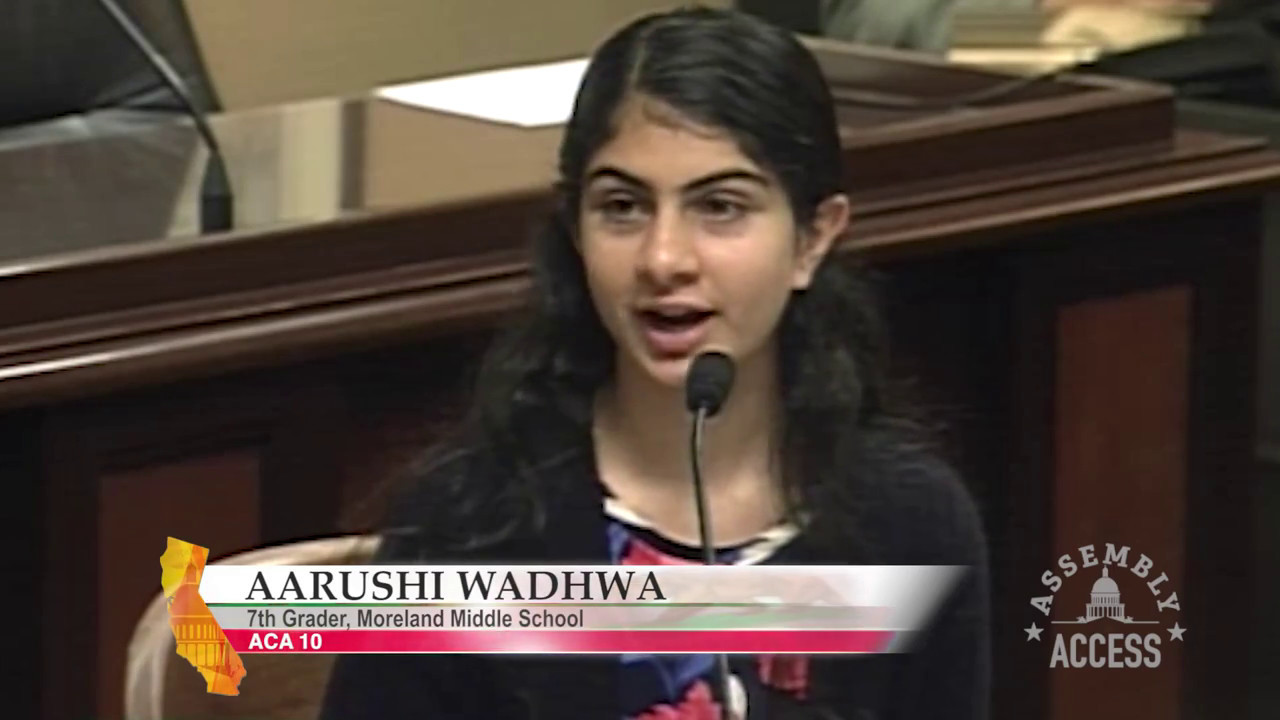
My inspiration is Malala Yousafzai, a Pakistani teen activist and the youngest-ever Nobel Prize laureate, who stood up for women’s education. I feel that standing up for what you believe in is indeed very important. At such a young age, Malala got involved in politics, and even spoke at the United Nations. This is why I felt just like a mini Malala when I testified in favor of the Assembly Constitutional Amendment 10 (ACA10) bill at the Capitol in Sacramento.


ACA10 bill is authored by Assembly Member Evan Low (D-Silicon Valley), and is a proposition to lower California’s voting age to 17. It has already passed the Assembly Elections Committee with a four to one margin, and the Assembly Appropriations, and is now on its way to the full Assembly floor.

Research by the California’s secretary of state’s office shows that only 8.2% of Californians age 18-24 actually voted in 2014 general elections. This is often because many 18 year olds are usually in a time of transition – graduating from high school, going to college, or getting a job. Lowering the voting age to 17 will catch youth at a time when they are still connected to their school, their home, and their community. Research has shown that the earlier in life one votes, the more likely they are to form a lifelong habit of voting. As a result, there has been a nationwide movement to engage youth earlier in the electoral process. 


We need bold ideas to reinvigorate participation in the democratic process,” says Assembly Member Low. “Lowering the voting age will help ensure the next generation is engaged and empowered to hold their representatives accountable.” Additionally, he states that the majority of 17 year olds have some sort of job, and they pay income tax; so it is unreasonable, to exclude a law-abiding, tax paying citizen from voting. Mr. Low likes to call this “taxation without representation.


I was ecstatic when I was invited to testify for the bill in early spring. I along with another Bay Area teen, Maya Bodnick, presented our views on why the voting age should be lowered, in front of the Committee. It was a very memorable experience to see activism up close, and speak about a topic that I recently started learning more about. Personally, I agree with all of Mr. Low’s arguments. 18 year olds are in a state in transition and have so much more to worry about while entering college, so voting becomes their last priority. If we want more voters, we must catch them while they are still connected to their communities, which means when they are 17. Also, they are definitely mature enough to make informed political decisions. I am part of my school's environmental club, the Greenkeepers. This club was started in 2012, when a group of middle schoolers successfully saved three 50–year old trees that were scheduled to be cut down by writing letters, and attending and speaking at numerous School Board meetings. We were even featured in the San Jose Mercury News article titled Activists Get Lesson in Democracy. Now, we are 50 students strong team and regularly engage in environmental community services. I am the youngest member of the Campbell Youth Commission, where we introduced a Social Host Ordinance to crack down on underage drinking and drug abuse. Last summer, I attended a Model United Nations camp where we learned about immigration reforms, and even had a mock parliamentary debate. And, I’m not the only one; there were almost 500 students that attended the Model UN camp and we have 15 Campbell Youth commissioners and as many, if not more, in other cities. Recently, youth commissioners from Campbell, Cupertino, and Saratoga cities organized Pizza and Politics event where we discussed topics like gun control, higher education, LGBT, and creepy clown menace with city mayors and district 15 candidates. If my peers and I can debate on such important topics, and ordinances, then we can definitely make a mature decision when it comes to voting, because in the end, it affects our own future.

I do understand that there is some resistance to lower the voting age because some feel that 17-year-olds lack civic sense. However, instead of just shunning the idea, we should empower teens. That is why Mr. Low also proposed bill AB189, which adds a service learning component to high school curriculum to prepare teens for voting. Just like when new technology (smart devices, social media, etc.) came out, no one knew how to use them. But instead of just getting rid of them, we embraced them. In fact, other Campbell Youth Commissioners and I hosted "Teens Teach Tech" event where we taught the elderly how to use technology. Quoting Confucius, “I hear and I forget. I see and I remember. I do and I understand.” If we want to enhance teens' civic engagement, we need to take the next step. 17 year olds hear about the elections, some see it, but they won’t understand it until they actually participate in the process. So, the main point is to embrace the change, get ready for it, and be part of the process.

In my view, it is extremely important to have the voting age lowered to 17. At this age, we pay taxes, we are mature, can make informed decisions, will be able to contribute to the society and shape our own future. I would definitely like to vote when I’m 17!

Tuesday, April 11, 2017

If...


If  we did not put our soldiers’ lives at stake,
They would be safe, and our hearts would not ache.

If we would have used words instead of guns,
We could have saved our country’s sons.

If now we understand that war is not the key,
We can start our call for humanity.

If  we understood that keeping animals in captivity is bad,
We would not have to see them miserable and sad.

If we hadn’t just closed our eyes,
We would realize that captive animals painfully die.

If now we all can be true animal lovers,
We can do something so animals won’t suffer.

If  we could understand that domestic violence leaves much more than bruises,
We could stop people from being so abusive.

If we would have dialed 911 in time,
We could have stopped a heinous crime.

If now we all take a stand,
We can stop domestic violence from plaguing our land.

If  we realize that drugs are not a solution to depression,
We can stop them from becoming an obsession.

If we can stand-up to the peer pressure for smoking weed,
We can stop drugs from being a need.

If now we can become the support system for everyone,
We can stop drugs from killing us one-by-one.

If  stereotypes weren’t perpetuated by society,
Everyone could have their own personality.

If we didn’t have certain expectations,
Everyone could have different aspirations.

If now we don’t judge or categorize,
Stereotypes will diminish, and we won’t have to live by lies.

If  there were no radicals to begin with,
Then terrorism would just be a myth.

If we would have sorted things out orally,
We could all live morally.

If now we forgive and forget,
We can live without a threat.

If  we are all together to end this disgrace,
We can, and will make the world a better place,
For birds, animals and the entire human race.

Wednesday, March 8, 2017

Be Strong, Be Courageous, Be Pink


As I always say, “There is no such thing as too much pink.

I have a pink room, pink clothes, pink supplies, pink everything, and this is the way it has been since the beginning of time, and it fits right in with my personality.

Pink, as I’m sure you’re aware, is a combination of red and white. It contains the action and energy of the color red, while also having the purity and maturity of the color white. It is a perfect blend between both colors, and represents me as a human being very well. When I am more proactive, a darker shade of pink would portray me better, and when I am calm, a lighter shade would describe me.

Pink is a delicate color that represents sweetness and femininity. Pink denotes friendship, harmony, and approach-ability. This represents me well, because often my friends find me easy to talk to when seeking comfort, and will almost never find me tangled up in drama.  Pink is also the color of universal love of oneself and of others. People who like pink are sensitive to the needs of others, along with being accepted and loved as their own greatest need. This might explain why I enjoy seeing people happy, especially when I am the reason for it; and also equally like when I’m showered with love.

Color pink takes its name from the flower Dianthus, which is commonly known as carnation, or pink. Even though pink got its name from “the pink” flower, it is often associated with other pink flowers like pink roses, lily, pink tulips and the Japanese cherry blossom. Whichever the flower is, they all spread fragrance and makes this world a beautiful place.
Pink is often used to stereotype girls as being soft and feminine. Yes, I am caring; I am sweet; I am sassy; I am lively; I am confident; I represent beauty and grace with inner strength and power, and I am every bit proud of being a girl.

Quoting Miley Cyrus, “Pink is not a color, it’s an attitude!”

Monday, February 13, 2017

AR-Zoo, the future of zoos!


I am sure we have all been to a zoo before and have enjoyed the experience. Most people go to zoos for entertainment, spending time with family, connecting with nature, and education. Growing up, I have been to the Happy Hollow Zoo, the Oakland Zoo, and the San Diego Zoo several times. I was always excited to see the monkeys jump from branch to branch, see the lion roar, or the cheetah run in circles. In fact, I would run over and press my nose to the glass cage for a better view. But, little did I know, that this pacing was due to a mental illness.

Captive animals live a very harsh life at zoos. Zoo confinement causes elephants to develop painful arthritis because there is not enough room for them to walk and stretch their muscles. Tigers and lions have around 18,000 times less space in zoos than they would in the wild and polar bears have one million times less space. That’s like a human being spending their lifetime in a bathtub! Everything would be so cramped!

For these reasons, some animals even risk their lives in desperate attempts to free themselves. At the Dallas Zoo, a gorilla was shot to death, while trying to escape. There is also a recent case of shooting the gorilla named Harambe at Cincinnati Zoo.

One possible solution for zoo captivity is an Augmented Reality Zoo. These AR-Zoos will be a combination of real animals, animatronics and holograms. Domesticated and endangered species will be the real animals in their natural habitat. Other wild animals, that we only see from far away in a normal zoo, will be replaced with real looking, life size animatronics. And, videos of animals from the wild will be projected as 3D holograms. This will keep the benefits of zoos intact while addressing the disadvantages of zoo confinement.


I am Aarushi Wadhwa, and this is the solution my team and I are proposing. We are team AR-Zoo, a Lego robotics team that consists of five 7th graders from Moreland and Cupertino schools. Driven by our passion for STEM and solving real-world problems, we are proposing this futuristic idea that will help get animals back into the wild where they belong, and at the same time giving the same fascinating zoo experience to humans.

We participated in First Lego League (FLL) Robotics tournament, which is an international competition organized by “FIRST” (For Inspiration and Recognition of Science and Technology) organization. This year's theme is Animal Allies, in which each team builds a robot to complete a certain set of missions, and to recommend a solution to make interactions between humans and animals better. We chose to address the problem of animal captivity, and our solution is AR-Zoo. In November, we took part in the qualifying tournament at NASA Ames Research Center and came 1st in the project area and in the top 5 in the robotics mission category. In January, we participated at the NorCal FLL Peninsula Champ regional robotics competition at Burlingame High School and received the “Coolest Project” and “Teamwork Award”. For the robotics mission category, we tied at 12th place.

We have shared this innovative solution with industry experts including Dr. Robert Visser (Applied Materials), Dr. Wendy Holforty (NASA), Dr. Mehmet Tek (Amazon), and animatronics experts at PETA, who all agree that an Augmented Reality Zoo is definitely the step forward.

In partnership with PETA, our team has recently showcased their life-size, charismatic, animatronics elephant, Ellie, at the West Valley Branch Library. Ellie interacted with the attendees about the tough lives of animals in confinement, and ways to help captive animals. Kids and parents, alike, were excited to see Ellie move and talk to them. This event was attended by approximately 75 people, making it a great success.


We have started an online petition about ending zoo captivity and instead use hi-tech solutions like an Augmented Reality Zoo. This is getting international endorsement, and has already received 650+ supporters, making it well on its way to the U.S. Department of Agriculture (USDA) Animal Care department.


We had the honor to receive the prestigious “Hero to Animals” Award from PETA, the world’s largest animal rights organization, for our innovative solution to stop animal captivity. Also, I had the opportunity to visit the PETA office and demonstrate our homemade hologram projector and have received very positive reviews.


Animals are not ours to eat, wear, experiment on, use for entertainment, or abuse in any way.

Next time, when I go to a zoo, and press my nose to the glass cage, I would like to see a robotics cheetah walking around, and in my heart I will be happy that the real one is running around freely in the wild.

Wednesday, November 30, 2016

Cross Hatching


Hatching comes from the French word “hachure” meaning series of short parallel lines. It is an artistic technique used to create tonal or shading effects by drawing closely spaced parallel lines. When lines are placed at an angle to one another, it is called cross-hatching.

Hatching and crosshatching are some of the most valuable tools for generating value and texture in a drawing. These techniques use simple lines in various arrangements and densities to create a solid sense of atmospheric perspective and contour. The representation of light utilizes the white or openness of the page, while shadow is created by a density of crossed lines.

Artists use the technique, varying the length, angle, closeness and other qualities of the lines to emphasize forms and to create the illusion of volume.

If you examine the value scale below, you can see how the left side uses a simple pattern of parallel lines spaced widely apart to represent light. The right side uses several layers of crisscrossing lines to create a feeling of shadow.


There are 6 basic forms of hatching and cross-hatching.

1) Parallel hatching- can be horizontal, vertical, or diagonal lines.
2) Contour hatching - follow the lines of the subject.
3) Cross-hatching - two layers of contour or parallel hatches, one on top of the other.
4) Fine cross-hatching - several layers of contour or parallel hatches, each on top of the other.
5) “Basket” or “woven” hatching - short sets of parallel hatches going one way, and another set of parallel hatches going almost perpendicular to the first set of hatches.
6) “Tick” hatching - small contour lines piled on top of one another, not necessarily crossing.

Some of the famous cross-hatching artists include Rembrandt van Rijn, Leonardo Da Vinci, and Edward Linley Sambourne.